Common Direct Mail Mistakes That Reduce Response Rates

Direct mail remains one of the most effective ways for businesses to reach local customers, generate leads, and increase sales. However, many companies experience disappointing results because of avoidable direct mail mistakes that reduce campaign effectiveness. From poor audience targeting to weak promotional offers, even small errors can negatively impact engagement and conversions.
Understanding these common issues can help businesses improve their direct mail response rate, maximize marketing budgets, and create campaigns that deliver measurable results.
Why Direct Mail Still Works for Local Marketing
Despite the growth of digital advertising, direct mail continues to be a powerful tool for local businesses. Unlike online ads that can be ignored or blocked, physical mail tangibly captures attention.
Benefits of direct mail marketing include:
- Strong physical visibility in homes and businesses
- Effective local audience reach
- Increased brand awareness
- Higher customer engagement compared to some digital channels
- Better audience targeting opportunities
- Long-lasting marketing exposure
Businesses that combine direct mail with other marketing channels often see stronger customer acquisition results and improved brand recognition within their communities.
What Are the Most Common Direct Mail Mistakes?
Many direct mail campaigns fail not because the channel is ineffective, but because critical planning and execution mistakes reduce performance. Understanding these issues can help businesses create more successful marketing campaigns.
Using an Outdated or Poor-Quality Mailing List
A poor-quality mailing list is one of the biggest causes of wasted marketing dollars.
Common problems include:
- Incorrect addresses
- Duplicate records
- Outdated customer information
- Poor audience targeting
For example, a local home services company may send thousands of mail pieces to households outside its service area. The result is wasted printing and distribution costs with little opportunity for conversion.
Regular list maintenance and audience verification help ensure marketing materials reach the right prospects.
Sending the Same Message to Everyone
Generic messaging often fails because different audiences have different needs.
A first-time customer may respond to a welcome discount, while a loyal customer may be more interested in an exclusive offer or rewards program.
Audience segmentation allows businesses to:
- Personalize messaging
- Improve relevance
- Increase customer engagement
- Deliver more targeted promotional offers
Even basic personalization can significantly improve campaign performance.
Weak or Unclear Offers
Many businesses focus heavily on design while overlooking the actual offer.
Common offer-related mistakes include:
- Generic promotions
- Minimal discounts
- Lack of urgency
- Complicated redemption requirements
Customers need a clear reason to respond. Limited-time discounts, exclusive coupons, free consultations, and special local promotions often generate stronger results than vague marketing messages.
Poor Design and Layout
Design plays a major role in campaign success.
Common design mistakes include:
- Cluttered layouts
- Excessive text
- Hard-to-read fonts
- Weak visual hierarchy
- Inconsistent branding
Whether using postcard marketing pieces or coupon mailers, recipients should immediately understand who the business is, what is being offered, and how to respond.
A clean, professional design helps guide readers toward the most important information.
Missing or Weak Calls to Action
A campaign may generate interest but still fail if recipients are not told what to do next.
Effective calls to action encourage customers to:
- Call a phone number
- Visit a website
- Scan a QR code
- Redeem a coupon
- Schedule an appointment
Without a strong call to action, businesses risk losing potential customers who may be interested but unsure how to proceed.
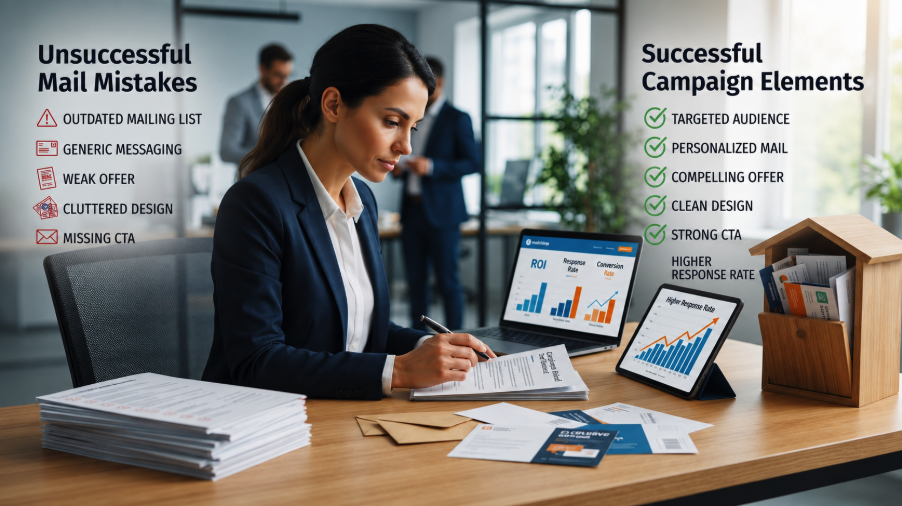
Top 5 Direct Mail Mistakes to Avoid
- Using an Outdated Mailing List – Sending mail to the wrong audience wastes budget and reduces effectiveness.
- Sending Generic Messages – Lack of personalization decreases relevance and engagement.
- Offering Weak Promotions – Customers need a compelling reason to take action.
- Overcrowding the Design – Too much information can overwhelm recipients.
- Forgetting a Clear Call to Action – Every piece should clearly explain the next step.
How Do These Direct Mail Mistakes Affect Response Rates?
Direct mail mistakes directly impact campaign performance in several ways.
Poor targeting means fewer qualified prospects receive the message. Weak offers reduce motivation to respond. Confusing designs make important information easy to miss, while missing calls to action create friction in the customer journey.
For example, a restaurant distributing coupon mailers with an expired offer or unclear redemption instructions may receive far fewer responses than expected. Similarly, a retailer sending generic promotions to a broad audience may experience lower conversions than a segmented campaign with personalized offers.
These mistakes collectively lower the overall direct mail response rate, reduce marketing ROI, and limit customer acquisition opportunities.
What Direct Mail Tips Can Improve Campaign Performance?
Following proven best practices can significantly improve results.
Know Your Audience
Successful campaigns begin with understanding customer demographics, interests, and buying behaviors.
Effective audience targeting helps businesses deliver relevant offers to the people most likely to respond.
Keep the Message Simple
One of the most effective direct mail tips is to focus on a single message.
Avoid overwhelming recipients with excessive details. Clear, concise messaging often produces stronger engagement and higher conversion rates.
Make the Offer Valuable
Customers are more likely to respond when they see genuine value.
Examples include:
- Percentage discounts
- Buy-one-get-one promotions
- Free consultations
- Exclusive local deals
- Limited-time incentives
Strong offers create urgency and encourage immediate action.
Test and Measure Results
Tracking campaign performance helps businesses identify what works and what needs improvement.
Useful tracking methods include:
- Coupon redemptions
- Dedicated phone numbers
- QR codes
- Unique tracking codes
- Landing pages
Regular testing allows marketers to optimize future campaigns and improve results over time.
How Does Print Marketing Complement Digital Marketing?
Effective print marketing works best when integrated with digital channels.
A multi-channel approach can:
- Increase brand recognition
- Reinforce marketing messages
- Build customer trust
- Improve local visibility
- Support online advertising efforts
For example, a business might send direct mail postcards promoting a special offer while simultaneously running social media and email campaigns. Multiple touchpoints help improve recall and increase conversion opportunities.
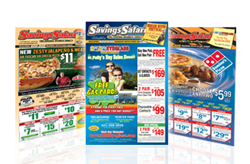
Companies such as Savings Safari help businesses strengthen local marketing efforts through targeted print advertising, coupon distribution, and promotional campaigns that complement broader marketing strategies.
Why Professional Direct Mail Planning Matters
A successful direct mail campaign requires more than printing and mailing materials.
Professional planning helps businesses improve:
- Audience targeting
- Offer development
- Campaign design
- Distribution strategy
- Performance measurement
Organizations like Savings Safari provide businesses with access to local advertising opportunities, coupon mailers, direct mail marketing programs, and print marketing solutions designed to connect brands with local consumers.
By combining strategic planning with accurate targeting and compelling offers, businesses can improve campaign performance and generate stronger results.
Conclusion
Avoiding common direct mail mistakes can dramatically improve campaign effectiveness and response rates. Businesses that focus on accurate audience targeting, strong offers, clear messaging, professional design, and compelling calls to action are more likely to achieve better engagement and stronger returns on their marketing investment.
Whether you’re launching your first campaign or refining an existing strategy, working with experienced providers such as Savings Safari can help ensure your direct mail efforts reach the right audience and deliver measurable results. Improve your direct mail strategy today, eliminate costly mistakes, and use targeted print marketing to generate more leads, increase customer engagement, and boost your direct mail response rate.
Frequently Asked Questions
What is a good direct mail response rate?
A typical direct mail response rate ranges from 2% to 9%, depending on the audience, industry, offer quality, and targeting accuracy. Well-targeted campaigns often outperform broad mailings.
How often should businesses send direct mail campaigns?
Many businesses benefit from sending campaigns monthly or quarterly. Consistency helps build brand awareness and improves customer recall over time.
Are postcards more effective than letters?
Postcards often generate quick attention because the message is immediately visible. Letters may perform better for complex offers that require additional explanation.
How can I track direct mail campaign results?
Businesses can track results using QR codes, coupon codes, dedicated phone numbers, personalized URLs, and landing pages designed specifically for the campaign.
Is direct mail still effective for small businesses?
Yes. Direct mail remains highly effective for small businesses, especially when targeting local audiences with relevant offers and clear calls to action.
coupon marketing strategies direct mail marketing strategies hyperlocal marketing strategies local marketing strategies